
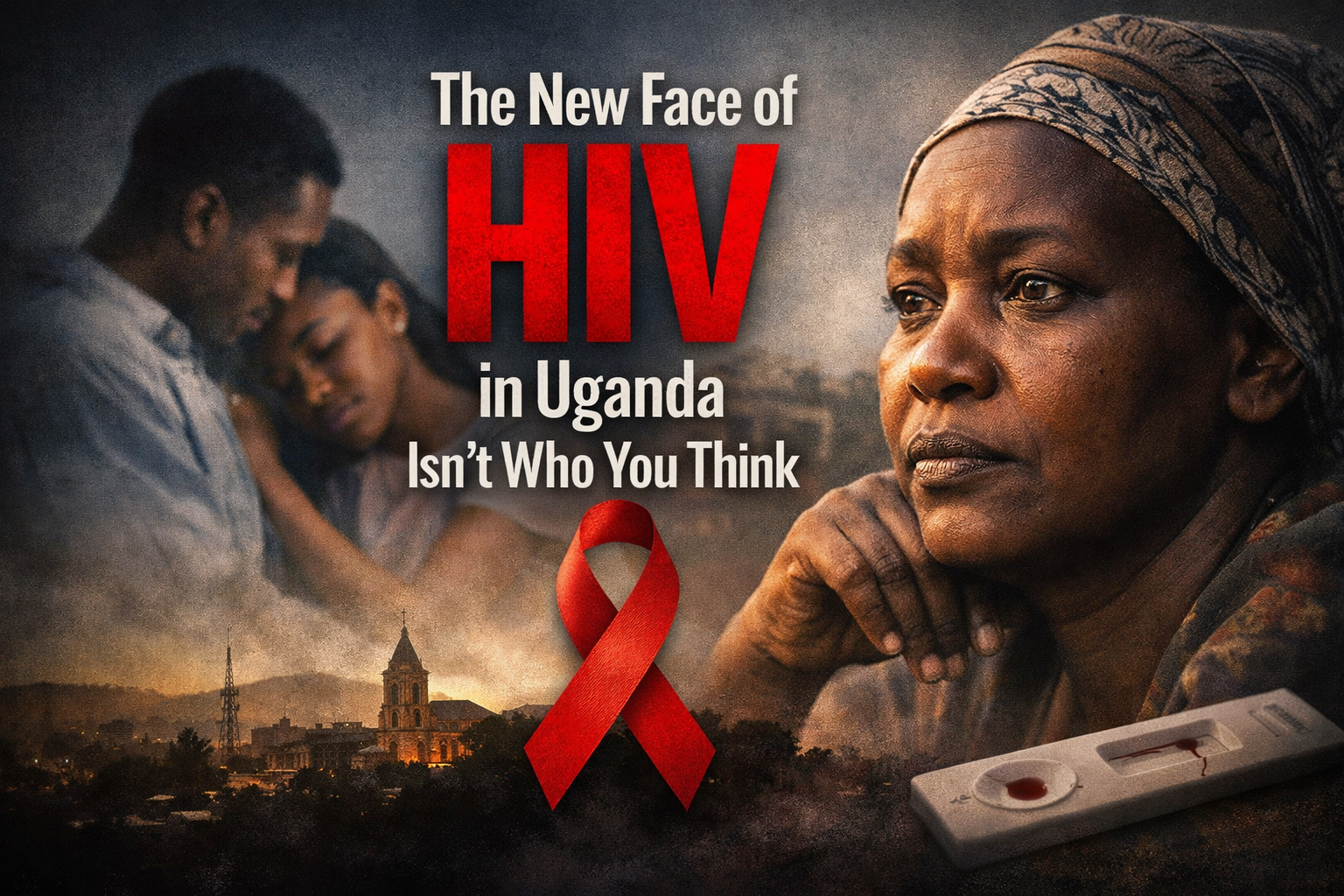
I remember the first time I realised that HIV doesn’t look the way we think it does.
It wasn’t in a hospital.
It wasn’t in a documentary.
It wasn’t even in a “high-risk” setting.
It was in a normal conversation.
A friend of mine — someone educated, careful, and fully aware of HIV — told me they had tested positive.
There was no “reckless story.”
No obvious mistake.
No moment you could point to and say, “That’s where it went wrong.”
Just a relationship.
Trust.
And silence.
That moment stayed with me.
Because it quietly destroyed a belief I didn’t even know I had —
that HIV happens to other people.
Today, that illusion is becoming dangerous.
In places like Mbarara, over 1,600 new HIV infections have been recorded in a single year. At first glance, it feels like a continuation of an old crisis.
But it’s not.
Because the people behind these numbers are not who we’ve been conditioned to expect.
They are:
- Young people who grew up hearing about HIV in school
- Men and women rebuilding their lives after divorce
- Individuals in relationships that look stable, loving, and “safe”
This is not the HIV story Uganda has been telling itself.
This is something else.
We didn’t fail to educate people. We failed to change behavior.
For decades, Uganda has been praised for its HIV awareness campaigns.
Entire generations grew up knowing:
- What HIV is
- How it is transmitted
- How to protect themselves
And yet, infections among young people are rising again.
That should disturb us.
Because it means the problem is no longer knowledge.
It’s behavior.
Somewhere along the way, HIV stopped feeling urgent.
It became:
- Treatable
- Manageable
- Less visible
And when something stops feeling dangerous, people adjust their behavior accordingly.
Condom use declines.
Testing becomes occasional instead of routine.
Risk becomes something abstract — something that happens to someone else.
I’ve seen this shift in conversations.
People don’t talk about HIV with fear anymore.
They talk about it with distance.
“It’s not like before.”
“People live normal lives now.”
“It’s manageable.”
All of that is true.
And all of it is part of the problem.
Because when fear disappears without discipline replacing it, risk fills the gap.
The group no one is talking about
If rising infections among youth are concerning, what’s happening among divorced and separated individuals is even more unsettling.
Because almost no one is paying attention to it.
I once spoke to someone who had recently gone through a divorce.
They described the experience not just as separation — but as disorientation.
“It felt like being dropped into a completely new world,” they said.
“You don’t know how to date anymore. You don’t even know who you are in that space.”
That vulnerability matters more than we admit.
After years in a committed relationship, people re-enter the dating world with:
- Emotional hunger
- A desire for connection
- A need to rebuild their identity
But they don’t re-enter with the same caution they might have had in their early twenties.
They trust faster.
They ask fewer questions.
They assume safety where it hasn’t been established.
And unlike younger people, they are often not the target of HIV prevention campaigns.
No one is speaking directly to:
- The man starting over in his late 30s
- The woman navigating love again after a broken marriage
So they move through this new phase of life without the same guardrails.
And quietly, they become part of the statistics.
HIV is no longer spreading where we think it is
For a long time, the narrative around HIV was simple.
It was framed around:
- High-risk behavior
- Casual encounters
- Lack of awareness
But that narrative is becoming increasingly disconnected from reality.
Because today, HIV is spreading through something far more ordinary.
Relationships.
Not just fleeting ones — but ongoing, emotionally significant ones.
It’s spreading through:
- Trust without testing
- Long-term partnerships where infidelity goes unspoken
- Situations where asking for a test feels like accusing someone
This is the part people don’t like to confront.
Because it forces us to question something deeply uncomfortable:
That love, trust, and familiarity do not automatically equal safety.
I’ve heard stories — too many of them — where someone says:
“I didn’t think I needed to test. I trusted them.”
That sentence carries more weight than any statistic.
Because it reveals the real driver of risk today.
Not ignorance.
Not recklessness.
But misplaced certainty.
The illusion of safety
There’s a quiet belief that lives in many people’s minds:
“This couldn’t happen to me.”
It doesn’t announce itself loudly.
It doesn’t sound irrational.
In fact, it often feels completely justified.
- “I’m not sleeping around.”
- “I’m in a serious relationship.”
- “I’m older now, I know better.”
But that belief is becoming one of the most dangerous factors in the spread of HIV today.
Because people don’t protect themselves from risks they don’t recognize.
And the nature of HIV risk has changed.
It no longer looks like something extreme or obvious.
It looks like:
- A partner you care about
- A relationship that feels stable
- A second chance at love
That’s what makes it powerful.
And that’s what makes it invisible.
We are fighting the wrong battle
If you listen closely to many HIV campaigns today, they are still speaking to an older version of the problem.
They emphasize:
- Awareness
- Abstinence or protection
- “High-risk groups”
But the reality on the ground has shifted.
We are no longer dealing with a lack of information.
We are dealing with:
- Behavioral complacency
- Emotional decision-making
- Social dynamics that discourage open conversations
You can know everything about HIV and still make decisions that put you at risk.
Not because you’re careless —
but because you’re human.
Because you want to trust.
Because you want connection.
Because you don’t want to disrupt something that feels good.
That’s where the real battle is now.
So what needs to change?
If Uganda is going to respond effectively to this new phase of the HIV epidemic, the conversation has to evolve.
We need to move beyond:
- Generic awareness messages
- Outdated stereotypes about who is at risk
- Silence around relationships and trust
And start addressing what is actually happening in people’s lives.
That means:
- Normalizing testing within relationships — not just before them
- Creating messaging that speaks to adults, not just youth
- Encouraging honest conversations, even when they feel uncomfortable
Because the solution is no longer just medical.
It’s social.
It’s emotional.
It’s behavioural.
Final thought
That conversation I had — the one that changed how I see HIV — wasn’t dramatic.
There were no warning signs.
No obvious lesson.
Just a quiet realization that something we think we understand… we don’t.
The face of HIV in Uganda has changed.
It’s no longer distant.
It’s no longer obvious.
And it’s no longer confined to the categories we’ve relied on for years.
It’s closer than we think.
And until we are willing to confront that — honestly, uncomfortably, and without assumptions —
the numbers will keep rising.
Not loudly.
But quietly, steadily, and in the lives of people who never thought it would happen to them.

Leave a Reply