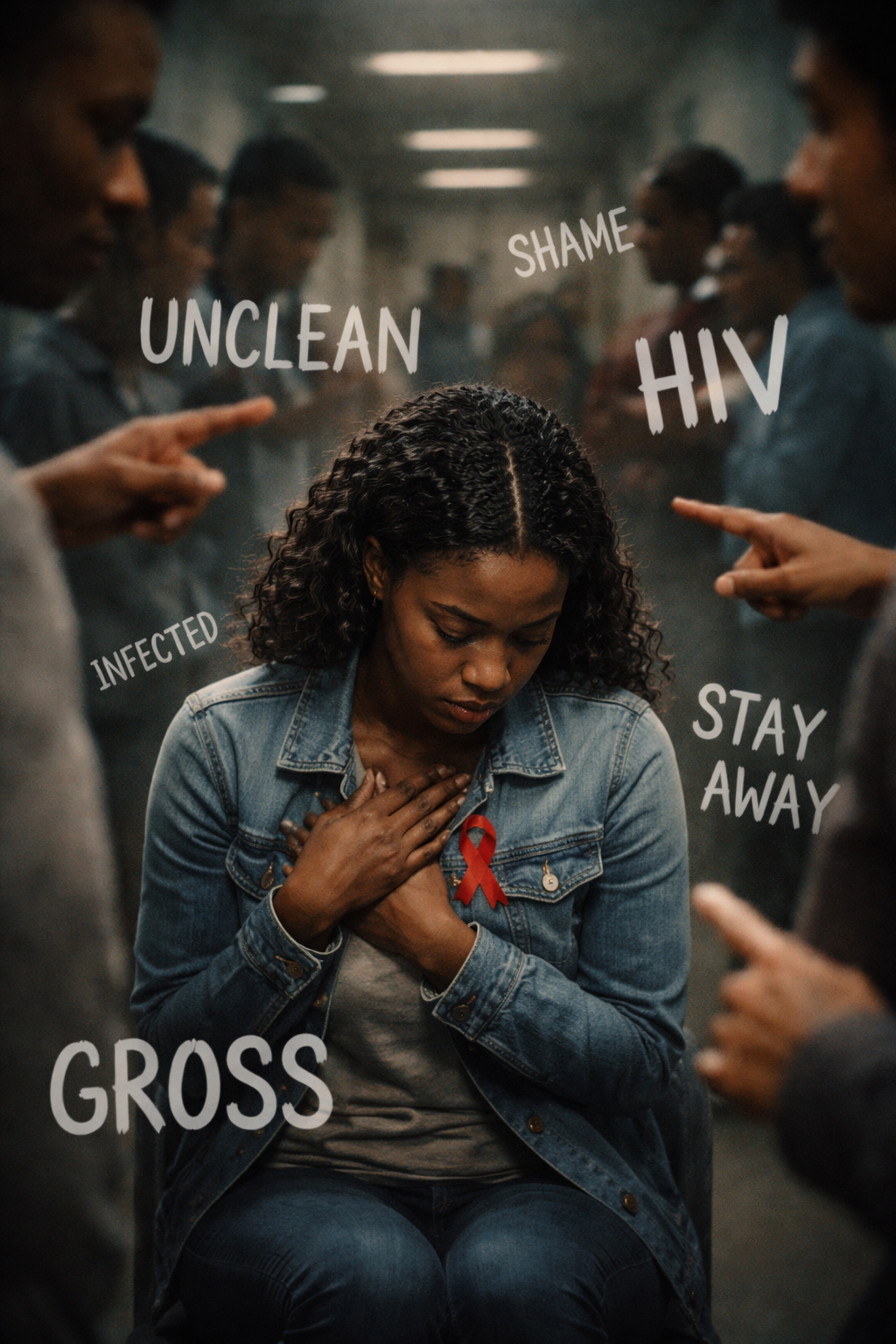
I used to think it was ignorance. I was wrong.
For a long time, I believed what everyone else believes about HIV stigma.
I thought people stigmatize because they don’t know better.
I thought if we educated people enough, stigma would slowly disappear.
I thought awareness was the solution.
But the more I lived with HIV…
The more I spoke to people…
The more I paid attention to how people actually behave…
I realized something uncomfortable.
It’s not ignorance.
Because the people around me are not as uninformed as we like to pretend.
They know.
They know HIV is not a death sentence.
They know treatment works.
They’ve heard about U=U.
They’ve seen campaigns. They’ve watched videos. They’ve read posts.
And yet… something doesn’t change.
Not fully.
Not where it matters most.
The Moment I Noticed the Gap
There’s something I started noticing in conversations.
People are very comfortable talking about HIV in general.
They’ll say things like:
- “There’s too much stigma.”
- “People living with HIV should be supported.”
- “Society needs to change.”
And I agree with them.
But then the conversation shifts.
It becomes personal.
And suddenly… the energy changes.
You see it in the hesitation.
In the pauses.
In the careful choice of words.
It’s subtle—but it’s there.
That’s when I started asking myself a harder question:
If people understand HIV… why do they still pull back?
What I Thought It Was… And What It Actually Is
At first, I thought maybe the education wasn’t deep enough.
Maybe they knew a little, but not enough to fully trust it.
But over time, that explanation stopped making sense.
Because I’ve met people who understand HIV very well…
And still keep their distance.
Not loudly. Not aggressively.
Just quietly.
And that’s when it hit me.
This is not about knowledge.
This is about fear.
The Fear No One Talks About
Let me say something that might make people uncomfortable:
Most people are not afraid of HIV itself.
They are afraid of what being associated with HIV will mean for them.
How they will be seen.
What people will assume.
What it might say about their choices, their identity, their reputation.
And that fear… is powerful.
Because we don’t live in isolation.
We live in communities.
In social circles.
In environments where perception matters.
So even when someone understands HIV scientifically…
They are still calculating the social cost.
I’ve Seen It Up Close
I’ve seen people support me in private…
And then hesitate in public.
I’ve seen people admire my work…
But struggle with closeness.
I’ve seen people who genuinely care…
But still create distance they don’t fully explain.
And I don’t always blame them.
Because I understand what they’re navigating.
But I refuse to pretend it’s ignorance.
It’s not.
The Performance of Acceptance
We’ve become very good at saying the right things about HIV.
We know what sounds supportive.
We know what sounds progressive.
We know what is expected.
But saying the right thing is not the same as living it.
Because real acceptance is tested in proximity.
- Who you sit with
- Who you love
- Who you are seen with
- Who you choose, publicly and privately
That’s where the truth shows up.
Not in statements.
In decisions.
The “Preference” Conversation
There’s a phrase I hear a lot.
“It’s just my preference.”
And on the surface, that sounds reasonable.
But I’ve learned to sit with that statement a little longer.
Because if someone understands U=U…
If they know the science…
If they believe HIV is manageable…
Then what exactly is that preference based on?
Because it’s not risk.
So what is it?
More often than not…
It comes back to perception.
Why This Is Hard to Admit
This is not an easy thing for people to confront.
Because it challenges how they see themselves.
Most people want to believe:
“I am informed. I am kind. I am not part of the problem.”
And in many ways, that’s true.
But stigma today is not always loud or obvious.
It’s quiet.
It lives in hesitation.
In distance.
In choices that feel personal—but are shaped by society.
And that’s harder to admit.
Where I Had to Be Honest With Myself
At some point, I had to stop asking:
“Why don’t people understand?”
And start asking:
“What are they afraid of?”
That question changed everything for me.
Because it shifted how I see stigma.
It’s not just something out there in “uneducated people.”
It exists in everyday interactions.
In people who mean well.
In people who care—but are still navigating fear.
Why Awareness Alone Is Not Enough
We’ve invested so much in awareness.
And it has helped. It really has.
But awareness alone cannot solve a problem rooted in social fear.
You can give someone all the information in the world…
And they can still choose distance.
Not because they don’t know.
But because they don’t want to carry the social weight of association.
The Conversation We Need to Start Having
If we’re serious about ending HIV stigma, we need to be more honest.
We need to move beyond:
“People just need more education.”
And start asking:
- Are we willing to stand close?
- Are we willing to be seen?
- Are we willing to challenge what people might assume about us?
Because that is where the real work is.
Not in knowledge.
In courage.
What I’ve Come to Accept
I don’t expect everyone to get this immediately.
I don’t expect everyone to be comfortable.
But I do expect honesty.
Because pretending this is just about ignorance…
Keeps us stuck.
And I’m no longer interested in comfortable conversations that go nowhere.
The Question I Leave You With
If you understand HIV…
If you believe the science…
If you say you support people living with HIV…
Then I want to ask you something simple:
What are you still afraid of?
Because until we answer that honestly…
Stigma will keep changing its shape—
But it will never really leave.

Leave a Reply