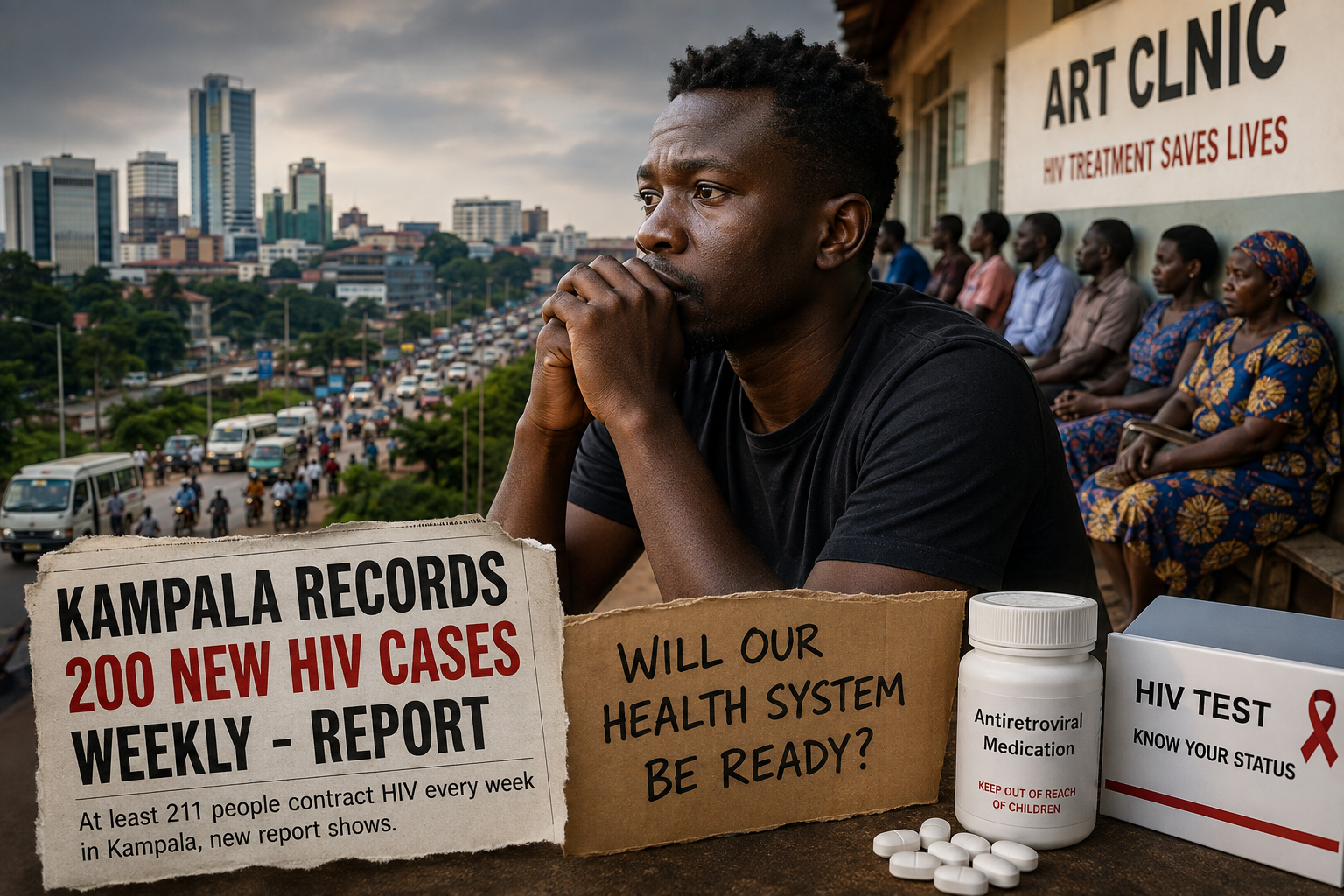
Uganda is being asked to take greater responsibility for its HIV/AIDS response just as worrying new numbers emerge. What happens if our health system cannot absorb the next wave?
There was a time when HIV/AIDS was impossible to ignore in Uganda.
It was everywhere.
In our homes.
In our schools.
In churches.
On radio programmes.
On billboards.
In hospitals.
People talked about HIV constantly because the consequences of ignoring it were impossible to hide.
Then something remarkable happened.
Treatment improved.
Testing became more accessible.
Prevention programmes expanded.
Mother-to-child transmission programmes became more effective.
People living with HIV began living longer.
And HIV gradually stopped feeling like the death sentence it once was.
That progress deserves recognition.
But I am increasingly worried that we may be entering a period where we take that progress for granted.
Because while Uganda is being asked to take greater responsibility for financing and sustaining its HIV response, new HIV-positive cases are still being identified at worrying levels.
And if we are not careful, we could find ourselves trying to solve tomorrow’s HIV crisis with yesterday’s assumptions.
The number that caught my attention
On August 24, 2026, Daily Monitor reported findings presented at the Kampala HIV/TB Stakeholders’ meeting showing that an average of 211 people were newly identified as HIV-positive every week in Kampala over the previous 12 months.
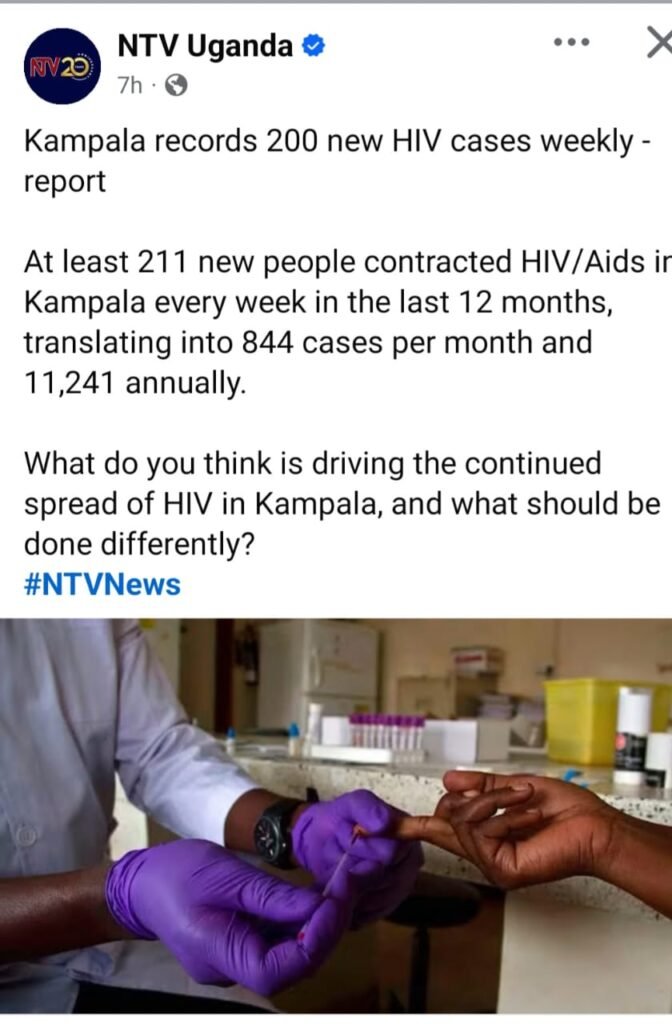
That translates to approximately 844 cases per month and 11,241 over the year.
The figures came from a Kampala Capital City Authority review of 649,570 people tested across health facilities between July 2025 and June 2026.
The numbers are concerning.
But there is an important distinction we must make.
These are people newly identified as HIV-positive through testing. That does not necessarily mean all 11,241 people acquired HIV during those twelve months. Some may have been living with HIV without knowing their status.
That distinction matters.
But whether these are recent infections, previously undiagnosed infections, or a combination of both, the message is still serious:
There are many people in Kampala who need an HIV response capable of finding them, linking them to care and preventing further transmission.
And that is happening at a time when the international financing landscape for HIV has been shaken.
The world that helped build Uganda’s HIV response is changing
For years, Uganda’s HIV response benefited enormously from international support.
The United States, particularly through PEPFAR—the President’s Emergency Plan for AIDS Relief—became one of the most important partners in the global HIV response.
PEPFAR helped support treatment, testing, prevention, laboratories, healthcare workers and community programmes across countries heavily affected by HIV.
But in 2025, the United States dramatically disrupted its foreign-aid system.
The consequences were felt in Uganda.
UNAIDS reported that ART-providing facilities in Uganda were operating at reduced capacity, while some community-led, peer-led, NGO-run and private facilities stopped services. The organization also reported reductions affecting prevention of mother-to-child transmission and early infant diagnosis.
This is important because it demonstrates something we sometimes forget:
HIV treatment is not just a bottle of tablets.
It is an entire system.
Someone has to procure the medicine.
Someone has to transport it.
Someone has to store it.
Someone has to prescribe it.
Someone has to test the patient’s viral load.
Someone has to monitor adherence.
Someone has to counsel the person who has just been diagnosed.
Someone has to trace the patient who stopped coming to the clinic.
Someone has to educate communities.
Someone has to prevent new infections.
Someone has to collect the data that tells us whether the programme is working.
When funding disappears, you don’t simply lose money.
You can lose pieces of the system.
But shouldn’t Uganda take care of its own people?
Yes.
Absolutely.
I actually believe Uganda should take greater responsibility for the health of Ugandans.
It is not sustainable for a country to depend indefinitely on foreign governments to finance essential healthcare.
At some point, ownership has to move home.
And Uganda is now moving in that direction.
In December 2025, Uganda and the United States signed a five-year health cooperation agreement worth about $2.3 billion, with the U.S. committing approximately $1.7 billion and Uganda approximately $600 million. The arrangement is intended to support a transition toward greater Ugandan ownership of health programmes.
That is not necessarily a bad thing.
In fact, it could become one of the most important opportunities for Uganda’s health system.
But there is a question we must ask honestly:
Is Uganda prepared to take over the responsibilities that international funding has been supporting while the demand for HIV services continues to grow?
Because a transition can be necessary and still be dangerous if it is badly managed.
The problem with thinking that treatment is the whole HIV response
This is where I think we need to be particularly careful.
Imagine the government manages to maintain medication for everyone who is already registered in HIV care.
That would be a tremendous achievement.
But what about the person who hasn’t tested?
What about the young man who thinks HIV cannot happen to him?
What about the woman who is afraid to test because of what her partner might do?
What about the person who stopped attending a community support group because the organization that supported them lost funding?
What about the person who lives far from a health facility?
What about people who need PrEP?
What about condoms?
What about HIV testing campaigns?
What about peer educators?
What about outreach to key populations?
What about adolescents?
What about men who rarely seek healthcare?
What about people who are newly diagnosed and need someone to help them understand that their life isn’t over?
These are the people who may not yet appear in the treatment statistics.
And if we ignore them, they become tomorrow’s treatment burden.
Prevention is the part we cannot afford to cut
This is one of the biggest lessons from the current funding disruption.
Treatment is visible.
Prevention is often invisible.
If someone takes ART today, we can count them.
If a person who is living with HIV becomes virally suppressed, we can measure it.
But if a young woman receives prevention services and never contracts HIV, there is no dramatic statistic saying:
“This infection was prevented.”
Yet that is exactly the outcome we want.
Global data already show the damage that funding disruption can cause to prevention. UNAIDS reported in 2026 that the number of people receiving PrEP across 62 countries fell by 38% in 2025 compared with 2024, while HIV testing also declined in high-burden countries.
That should worry us.
Because prevention is where we stop tomorrow’s infections.
If we only focus on treating people after they become infected, we will eventually be overwhelmed by the demand we failed to prevent.
What happens when the system becomes overwhelmed?
This is where my mind goes.
Uganda already has a large population of people living with HIV.
Now imagine thousands more people being diagnosed every year.
Imagine clinics becoming busier.
Imagine healthcare workers having larger patient loads.
Imagine laboratories facing greater demand.
Imagine community organizations losing the resources needed to support patients.
Imagine medicine procurement becoming more difficult.
Imagine viral-load monitoring being delayed.
Imagine people being given shorter medication supplies because health authorities are trying to manage limited stock.
What happens then?
We cannot assume that nothing will go wrong.
We have already seen warning signs.
Research published in 2026 examining the effects of the PEPFAR funding disruption in Eastern Uganda reported disruptions in HIV services and declines in viral suppression, illustrating how vulnerable service delivery can become when external support is suddenly withdrawn.
This is precisely why transition needs to be carefully managed.
I have already heard a warning from Zimbabwe
Earlier this year, I had the opportunity to interact with people living with HIV in Zimbabwe.
Some of the stories I heard stayed with me.
People described shortages and disruptions in access to treatment.
One of the things that particularly disturbed me was hearing concerns about people trying to find HIV medicines outside the normal health system when supplies became difficult to access.
I want to be careful here.
I am not claiming that Uganda currently has a widespread black market for ART.
I do not have evidence to make that claim.
But I think the possibility deserves serious discussion.
Because we know something about human behaviour:
When people depend on a medicine to stay alive and legitimate supply becomes uncertain, they will find ways to obtain it.
People will borrow.
They will stockpile.
They will travel.
They will ask other patients.
And if legitimate systems fail badly enough, informal markets can emerge.
We have already seen evidence of patients stockpiling ARVs because of fears of shortages during the recent funding disruptions in Uganda. Researchers studying services in mid-western Uganda found that patients accumulated medicines as a precaution, which contributed to stock-outs at some facilities.
Zimbabwe has also experienced treatment-supply pressures, including reductions in the amount of medication some patients received as authorities tried to manage shortages following the funding disruption.
That should be a warning to us.
Because an informal market for ART would be extremely dangerous.
People could be sold counterfeit medicines.
People could receive the wrong drugs.
People could receive expired medication.
People could be exploited financially.
And interruptions or inappropriate treatment can contribute to drug resistance.
We should prevent that crisis rather than wait for it to arrive.
The people living with HIV cannot be an afterthought
This conversation sometimes becomes very political.
America.
Uganda.
Donors.
Government.
Budgets.
Funding.
But I want to bring it back to the person sitting in a clinic.
The mother taking her medication.
The young man who has just tested positive.
The child who was born HIV-free because prevention of mother-to-child transmission worked.
The grandmother raising grandchildren.
The man who has finally decided to test after years of avoiding the clinic.
The person who depends on their local support group.
These people cannot afford political transitions that fail.
They cannot afford bureaucratic delays.
They cannot afford medicine shortages.
They cannot afford health systems that are told to “do more” without being given the resources to do it.
And they certainly cannot afford us assuming that HIV is no longer a serious problem.
Community organizations are not optional
This is something I know personally.
In the organization where I work, we have 85 support groups.
Most of the members are women.
These groups are not simply places where people meet.
They are part of the social infrastructure that keeps people connected to care.
People encourage one another.
They share experiences.
They support adherence.
They fight stigma.
They help newly diagnosed people understand that HIV does not mean the end of life.
And they create something that a hospital cannot always provide:
belonging.
That matters.
A person can receive medication from a clinic and still feel completely alone.
Sometimes what keeps that person in care is another person saying:
“I take these medicines too. You are not alone.”
When funding for community organizations disappears, we don’t simply lose an organization.
We can lose the bridge between the health system and the people it is trying to serve.
The men are another blind spot
There is another issue we cannot ignore.
In our 85 support groups, most members are women.
But men are also living with HIV.
And men often engage with HIV services differently.
We know that men have historically lagged behind women in HIV testing and treatment engagement in many African settings.
Some men wait until they are seriously ill before seeking care.
Some are afraid of being tested.
Some fear the implications for their relationships.
And in our own community work, we have encountered situations where men have taken their spouses’ ART medicines without ever going to a health facility themselves.
That is dangerous.
It is also a sign that HIV prevention and treatment cannot simply be about making services available.
We have to understand why people don’t use them.
If the next phase of Uganda’s HIV response is designed around the people who are already easy to reach, we will miss the people who are hardest to reach.
And those people may eventually arrive at our hospitals when their HIV is advanced.
We cannot treat our way out of a prevention failure
This is perhaps my biggest concern.
Imagine Uganda successfully maintains ART for the current population living with HIV.
That is good.
But if new infections continue rising, the number of people needing treatment will continue to increase.
Eventually, the system has to absorb them.
More patients.
More medication.
More healthcare workers.
More laboratory tests.
More counselling.
More community support.
More money.
And then another generation becomes dependent on a system that is already under pressure.
That is why prevention is not a luxury.
Prevention is financial planning.
Every infection prevented today is one fewer person who will require lifelong HIV treatment.
Every person who tests early is one fewer person likely to arrive at the hospital with advanced disease.
Every young person who understands HIV is an opportunity to prevent another infection.
Every person reached through PrEP, condoms, testing and education is part of protecting the future of Uganda’s health system.
I don’t want Uganda to depend on America forever
I want to say this very clearly because I don’t want this article misunderstood.
I am not arguing that Uganda should remain dependent on American money indefinitely.
I don’t believe that is sustainable.
I don’t believe it is dignified.
And I don’t believe it is the future we should want.
Uganda should progressively finance its own health system.
Our leaders should be able to say:
“These are our people. This is our responsibility.”
But if that is the direction we are taking, then we need to be honest about what it will require.
Domestic ownership must mean domestic investment.
Not simply domestic responsibility.
The government cannot inherit a health system and then expect it to function without adequately financing it.
Show us the plan
This is where I believe Ugandans should be asking difficult questions.
How much will Uganda spend on HIV over the next five years?
How much additional domestic funding will be required?
How will ART procurement be protected?
How will we prevent stock-outs?
How will we maintain viral-load testing?
How will we retain healthcare workers?
How will community organizations be supported?
How will we reach men?
How will we reach adolescents?
How will we expand HIV prevention?
How will Uganda respond if new infections continue rising?
And perhaps most importantly:
What happens if the number of people requiring HIV services grows faster than our health budget?
These aren’t unreasonable questions.
They are responsible questions.
The next HIV crisis may not look like the last one
When people hear the words “HIV crisis,” they may imagine the 1990s.
Hospitals full of dying patients.
Funerals.
Orphans.
Fear.
Stigma.
That may not be what the next crisis looks like.
The next crisis could look much quieter.
A clinic with fewer healthcare workers.
A patient told to come back later.
A laboratory unable to perform a test.
A community programme that quietly closes.
A man who never tests.
A young woman who loses access to prevention services.
A patient who begins stockpiling medication.
A health worker who has too many patients.
A newly diagnosed person who never receives adequate counselling.
Individually, these things may look small.
Together, they can become a crisis.
We have the tools. Do we have the political will?
That is ultimately the question.
Uganda does not lack knowledge.
We know how HIV is transmitted.
We know how to prevent it.
We know how to test for it.
We know how to treat it.
We know how to suppress the virus.
We know that a person who is virally suppressed does not sexually transmit HIV.
We know how to prevent mother-to-child transmission.
We have medicines that allow people living with HIV to live long lives.
The problem is no longer simply:
“Do we know what to do?”
The question is:
“Are we willing to invest enough to do it?”
Because knowledge without implementation does not save lives.
I am worried—but I am not hopeless
I want to be honest about where this article comes from.
It comes from concern.
But it also comes from hope.
I have lived long enough with HIV to know what is possible.
I was born at a time when HIV was far more frightening than it is today.
I have watched treatment transform lives.
I have watched people living with HIV build families, careers and businesses.
I have watched children who might once have been lost to AIDS grow into adults.
I have watched communities become stronger.
So I know progress is possible.
But I also know that progress can be lost.
The current funding transition is not automatically a disaster.
Uganda taking greater ownership of its health system could ultimately make the HIV response stronger and more sustainable.
But only if we take the transition seriously.
Only if government invests.
Only if prevention remains a priority.
Only if community organizations are protected.
Only if people living with HIV have a voice.
Only if we pay attention to new infections.
Only if we prepare for increased demand rather than waiting until the system is overwhelmed.
We should not wait for the shelves to become empty
This is my biggest message to our leaders.
Don’t wait until people are standing outside clinics asking for medicine.
Don’t wait until healthcare workers are overwhelmed.
Don’t wait until community organizations have disappeared.
Don’t wait until new HIV infections have doubled.
Don’t wait until people start buying ART from people they don’t know.
Don’t wait until a generation that thought HIV was under control discovers that it isn’t.
Prepare now.
Invest now.
Test now.
Prevent now.
Strengthen community systems now.
Listen to people living with HIV now.
Because once a health crisis becomes visible to everyone, it is usually already much more expensive to fix.
Uganda cannot afford to go backwards
We have come too far.
Millions of people have benefited from the HIV response.
Families have been preserved.
Children have grown up.
Parents have remained alive.
Communities have become stronger.
And people like me—people who were born with HIV—have had the opportunity to live lives that earlier generations could hardly imagine.
I don’t want us to lose that.
I don’t want my generation to become the generation that inherited the gains of the HIV response and then watched them disappear.
Uganda should take responsibility for its people.
America and other international partners should support a responsible transition.
Civil society must continue to hold governments accountable.
Communities must remain involved.
And people living with HIV must not be treated as passive recipients of policy.
We are citizens.
We are workers.
We are parents.
We are leaders.
We are voters.
And many of us have spent decades helping fight this epidemic.
We have a right to ask what happens next.
Because the question before Uganda is no longer simply:
“Can we treat the people living with HIV today?”
It is much bigger.
Can Uganda build a health system strong enough to protect the people who will need it tomorrow?
The answer cannot be a speech.
It cannot be a promise.
It cannot be a donor proposal.
It has to be a system that works.
Because I don’t want us to look back ten years from now and ask:
“How did we allow the progress to disappear?”
We have the knowledge.
We have the medicines.
We have the people.
We have the experience.
Now we need the courage to invest in the future.

Leave a Reply