When people hear that an organization is giving goats, pigs, or chickens to vulnerable families, the reaction is often the same:
“That’s a nice donation.”
But what many people fail to see is that livestock is not simply a gift.
It is an investment.
When managed well, a single animal has the potential to improve household income, increase food security, strengthen resilience, and restore dignity.
After working with communities affected by HIV/AIDS across Uganda, I have seen firsthand how livestock can become one of the most effective tools for sustainable community development.
Poverty Is Often a Lack of Assets
Many families living in poverty are hardworking.
They farm.
They raise children.
They search for opportunities.
Yet despite their efforts, they often remain trapped in poverty because they lack productive assets.
Without an asset that can generate income, every financial challenge becomes an emergency.
School fees become difficult.
Medical expenses become overwhelming.
Unexpected setbacks push families even deeper into hardship.
Livestock changes that equation.
A goat, pig, or flock of chickens becomes an asset that can grow in value rather than lose it.
Livestock Creates Income
Unlike many forms of assistance that are consumed once and gone, livestock has the ability to generate ongoing value.
Animals can reproduce.
Offspring can be sold.
Some animals produce milk or eggs that improve household nutrition while also creating products that can be sold for additional income.
For many families, livestock becomes the beginning of a small but sustainable business.
Income earned from livestock often helps pay school fees, purchase farming inputs, improve housing, or cover medical expenses.
Instead of relying solely on outside assistance, families begin creating opportunities for themselves.
Building Financial Resilience
Life is unpredictable.
Illness, crop failure, or unexpected household expenses can place enormous pressure on vulnerable families.
Livestock provides a form of financial security.
When emergencies arise, families have an asset they can sell if necessary.
This reduces dependence on high-interest loans or the sale of essential household possessions.
For many rural households, livestock functions much like a savings account—one that can grow over time.
Food Security and Better Nutrition
The benefits extend beyond income.
Livestock contributes directly to healthier families.
Chickens provide eggs.
Cows and goats can produce milk.
Manure improves agricultural productivity.
Families are able to diversify their diets and improve nutrition, particularly for growing children.
Healthy families are better equipped to learn, work, and participate in community life.
The Story of One Goat
One of the most inspiring examples from our Livestock Empowerment Project comes from a mother in Fort Portal.
She received one goat.
Rather than selling it immediately to meet short-term needs, she cared for it until the right opportunity came.
She sold the goat and purchased a calf.
She raised the calf until it became a mature cow.
When she eventually sold the cow, she used the proceeds to build a house.
Today, that house provides shelter for her and her five children.
Her story reminds us that development is not measured by the size of the first gift.
It is measured by what people are able to build with the opportunities they receive.
Livestock Restores Dignity
Perhaps the greatest benefit of livestock is one that cannot easily be measured.
It restores dignity.
There is something deeply empowering about earning an income through your own effort.
Parents regain confidence when they can provide for their children.
Widows discover they still have the ability to build a better future.
Young people begin seeing themselves as entrepreneurs rather than victims of circumstance.
Development should never create dependency.
Its purpose is to strengthen people’s ability to shape their own future.
Livestock helps make that possible.
What We Have Learned
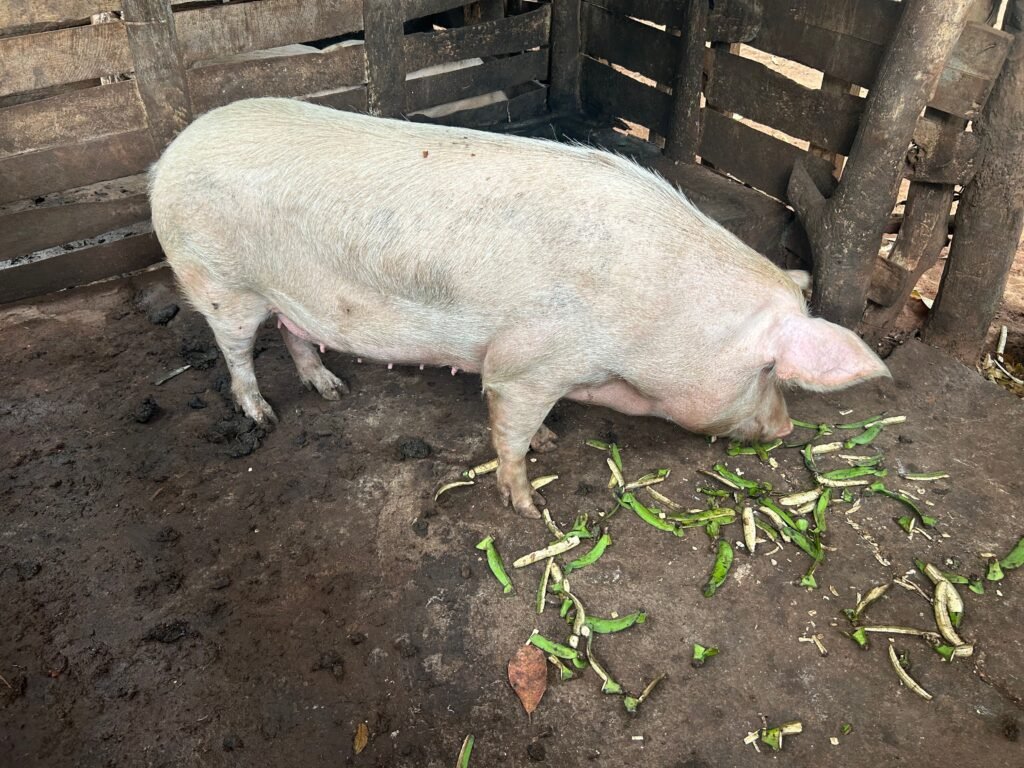
Through He Intends Victory Uganda’s Livestock Empowerment Project, we have distributed:
- 87 pigs
- 183 goats
- 300 chickens
These animals have reached members across 81 community support groups, serving a network of 1,625 people affected by HIV/AIDS.
While the numbers are encouraging, the greatest impact is found in the stories behind them.
Widows are earning income.
Children are staying in school.
Families are improving their homes.
Communities are becoming more resilient.
Each story begins with the same principle:
Opportunity creates transformation.
Looking Beyond Charity
Too often, development is measured by how much we give away.
I believe we should measure it by how much people are able to build for themselves.
Livestock is powerful because it shifts the conversation.
Instead of asking, “How long can we continue helping this family?”
We begin asking, “How can this family create lasting prosperity?”
That question changes everything.
A Future Built on Opportunity
Livestock will not solve every challenge facing vulnerable communities.
Education remains essential.
Healthcare remains critical.
Access to clean water remains a basic human need.
But when combined with these other investments, livestock becomes a powerful catalyst for lasting change.
It helps families move from survival to stability.
From dependency to self-reliance.
From uncertainty to hope.
Sometimes, the journey toward a better future begins with something as simple as a goat, a pig, or a few chickens.
The animal itself is not the miracle.
The miracle is what people are capable of achieving when they are trusted with opportunity.
And that is why I believe livestock is not just about farming.
It is about restoring dignity, creating opportunity, and empowering families to build a future that lasts.

Leave a Reply